Solid-state batteries: two routes to finally tame lithium
Replacing the liquid in batteries with a solid promises safer, denser batteries. In 2026, two teams attack the problem from two different ends: strengthening the existing solid, or inventing a new one.
Written with AISources checked2 sources · review in progress
What the sources say
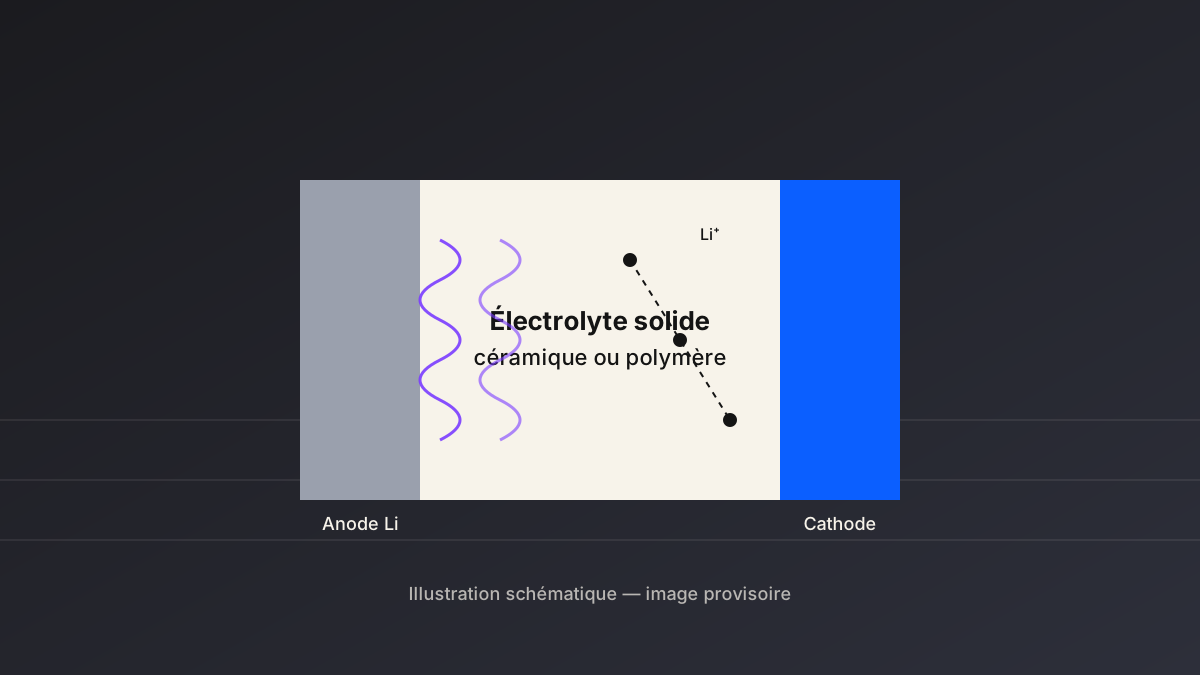
At Stanford, researchers deposited a 3-nanometre layer of silver on a ceramic electrolyte called LLZO, then heated it to 300 °C. The silver, which stays as charged ions, penetrates the surface to a depth of 20 to 50 nanometres and makes the material about five times more resistant to cracking [1].
These ions also keep lithium from seeping in and forming destructive branches inside the electrolyte [1].
In Japan, Akihide Ichikawa’s team describes an entirely new crystal structure, RbLi(Li3SiO4)2, made of light elements and designed for fast lithium-ion conduction [2].
Why it matters
The weak point of solid-state batteries is those lithium branches that crack the electrolyte and cause short circuits. Stanford repairs the existing material; the Japanese team looks for a new one. Two branches aiming at the same lock.
The rest is for subscribers
Subscribe to read the full article, access the "Quid si" recipes and support a newsroom that cites its sources.
Prototype: the buttons do nothing yet. Already subscribed? Login will come with the next version.
The timeline
Thread : Solid-state batteries · 3 steps
Johan August Arfwedson discovers lithium, in Sweden.
Stanford hardens LLZO with silver [1].
New crystal framework RbLi(Li3SiO4)2 [2].
Sources
- Stanford University, Heterogeneous doping via nanoscale coating impacts the mechanics of Li intrusion in brittle solid electrolytes, Nature Materials, 2026 · DOI 10.1038/s41563-025-02465-7↩
- Ichikawa A. et al., UCr4C4-Type RbLi(Li3SiO4)2: A New Solid Electrolyte Framework for Fast Li-Ion Conduction, Advanced Functional Materials, 2026 · DOI 10.1002/adfm.78600↩
Reviewed and corrected by review in progress · the teamReport an error